Research peptides
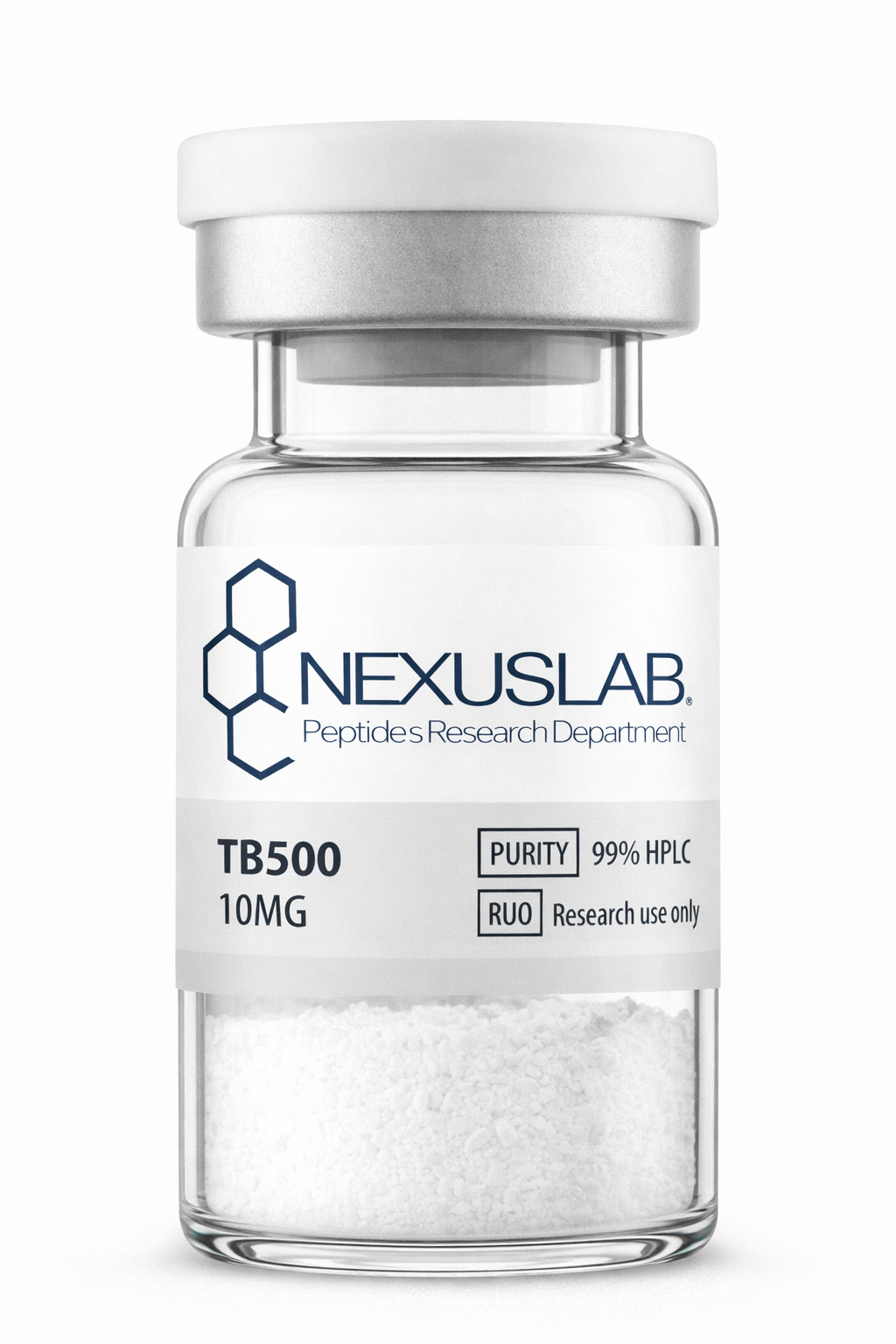
TB 500 (Timosina Beta 4)
Available documentary data and items still to verify are detailed below.
Price incl. VAT€90.00
AvailabilityAvailable
SKUTB 500
Loading availability…
 0
0
Research peptides
Available documentary data and items still to verify are detailed below.
Loading availability…
02 — Information to verify
TB-500 is a name associated with a fragment of thymosin β4. The peptide fragment must be distinguished from the full protein: its name, sequence, and terminal modifications define different molecular species.
Technical data
Catalog format: 10 mg. The listed structural record describes Ac-LKKTETQ, a seven-residue fragment with N-terminal acetylation. Its formula and mass include the acetyl group.
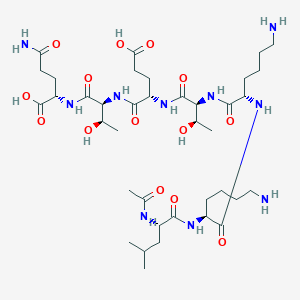
Reference molecular data.
View the PubChem record — PubChem CID 62707662
The record describes the N-acetylated fragment Ac-LKKTETQ, not full-length thymosin β4. Formula and mass include the acetylation, which is absent from the abbreviated sequence LKKTETQ.
Research considers cell migration, actin, and extracellular-matrix remodelling. The cited analytical paper examines identification of TB-500 and its metabolites by chromatography and mass spectrometry. Studies of full-length thymosin β4 do not automatically establish the same properties for the fragment.
The seven-residue fragment and full-length thymosin β4 are different experimental entities. N-terminal acetylation changes formula and mass without changing the seven sequence letters. Comparing studies requires material identity, termini, and analytical methods rather than the TB-500 name alone.
Actin dynamics connect the cytoskeleton with adhesion and cell movement. In thymosin-β4-family research, migration, proliferation, and differentiation describe different processes. Fragment research must determine which full-protein interactions are retained rather than assuming they all transfer.
Tissue remodelling depends on both matrix deposition and degradation. Metalloproteinases (MMPs) and their inhibitors (TIMPs) are studied within this balance. The liver-fibrosis review describes these general mechanisms; it is not an experiment establishing the same effects for the TB-500 fragment.
Biomaterials research includes supporting matrices, controlled signal release, macrophage polarisation, and stem-cell interactions. Some papers evaluate muscle repair and transcriptomes after volumetric muscle loss. These are studies of complex platforms, not evidence that peptide alone reproduces every result.
10.1002/jbm.a.37239 10.1016/j.bioactmat.2021.04.017 10.1186/s12891-023-06401-1
The 2012 analytical paper studies TB-500 in equine urine and plasma using liquid chromatography and mass spectrometry. Separation, fragmentation, and metabolite recognition distinguish it from related peptides. A detection method does not establish biological efficacy or safety.
Catalog of products presented for research activities. Not for human or veterinary use. This notice does not replace verification of applicable rules.