
Research peptides · Specialized research compounds
Retatrutide
Available documentary data and items still to verify are detailed below.
Price incl. VAT€150.00
AvailabilityAvailable
SKUInformation to verify
Loading availability…
 0
0
Research peptides · Specialized research compounds
Available documentary data and items still to verify are detailed below.
Loading availability…
02 — Information to verify
Retatrutide, identified in the literature as LY3437943, is a modified peptide studied as an agonist at GIP, GLP-1, and glucagon receptors. Its scientific context concerns interactions between incretin signalling and energy metabolism.
Technical data
Format: 20 mg. PubChem molecular reference CID 171390338 describes a 39-residue peptide with modifications that cannot be represented by a simple standard-amino-acid sequence.
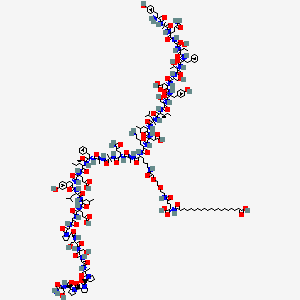
Reference molecular data.
View the PubChem record — PubChem CID 171390338
The complete structure includes non-standard residues, a lysine modification, and an amidated terminus. The abbreviated notation in the source is not a complete structural sequence; the PubChem record describes the reference molecule.
References include a phase 2 body-weight study and a randomised phase 2a study of metabolic liver steatosis. They concern the investigational compound and formulations defined by the study protocols.
The GIP receptor belongs to incretin signalling and participates in endocrine responses to nutrients. Multi-agonist research examines its interaction with GLP-1R and GCGR. Activity at one isolated receptor does not describe the integrated effect of the whole molecule.
GLP-1R signalling is studied in relation to glucose-dependent insulin secretion, gastric emptying, and satiety circuits. These processes require different measurements. A weight change in a trial does not separately quantify the contribution of each receptor pathway.
Glucagon participates in substrate mobilisation and liver metabolism. Triple-agonist research examines how this component balances with incretin actions. Describing glucagon as simply glucose-lowering is inaccurate; responses depend on signal integration and metabolic context.
The NEJM and Lancet papers examine obesity and type 2 diabetes populations respectively. Randomisation, comparison groups, and duration define interpretation. Body weight, glycated haemoglobin, and tolerability are separate endpoints; percentages from different populations should not be treated as equivalent.
The Nature Medicine study evaluates metabolic liver steatosis using liver-fat measurements. Other references examine lipoprotein profiles or collect findings in reviews and conference abstracts. A full clinical paper, secondary analysis, and abstract provide different levels of methodological detail.
Catalog of products presented for research activities. Not for human or veterinary use. This notice does not replace verification of applicable rules.